
Introduction
Biofilms are not random collections of bacteria attached to a surface.
They are highly coordinated systems.
One of the most important mechanisms involved in biofilm formation is:
👉 Quorum sensing.
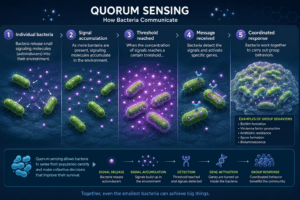
This bacterial communication system allows microorganisms to detect each other, coordinate behaviour, and activate genes linked to biofilm development.
What Is Quorum Sensing?
Quorum sensing is a microbial communication system based on chemical signalling molecules called:
👉 Autoinducers.
As bacteria attach to a surface, they begin releasing these signalling molecules into their surroundings.
As bacterial numbers increase:
- Signal concentration rises
- Nearby bacteria detect the signals
- Collective behavioural changes occur
What Happens When Quorum Sensing Activates?
Once quorum sensing is activated, bacteria begin switching on genes related to:
- Biofilm formation
- EPS production
- Virulence
This is a critical stage because the bacteria begin behaving as:
👉 A coordinated community rather than isolated cells.
Why This Matters in Food Processing
Quorum sensing helps explain:
- Why biofilms develop rapidly
- Why mature biofilms become resistant
- Why contamination can persist despite cleaning
Once communication begins:
- EPS production increases
- Attachment strengthens
- Biofilm structure stabilises
This significantly increases resistance to cleaning and sanitising.
Why Traditional Hygiene Approaches May Struggle
Many sanitation systems focus on:
- Killing exposed bacteria
- Reducing microbial counts
However:
👉 Biofilm bacteria are actively coordinating survival responses.
This is one reason why recurring contamination can continue even when hygiene protocols appear correct.
Key Takeaway
Biofilm formation is not accidental.
It is a coordinated microbial survival strategy driven by communication and collective adaptation.
At Innogiene …
Effective biofilm control starts with early detection before mature communication-driven biofilms become fully established.
At Innogiene, we help food processing facilities detect biofilms on open surfaces and monitor bacterial settlement inside pipelines and industrial water systems in real time.