
Biofilm detection in food processing often becomes critical when microbiological results begin to spike without an obvious explanation.
You investigate. You clean. You sanitise.
The results return to acceptable levels.
Then, weeks or months later, the problem appears again.
For QA and Food Safety teams, intermittent microbial spikes like these can be extremely frustrating. The cleaning programme appears to be working, yet somewhere in the facility microorganisms may be surviving.
One possible explanation is biofilm.
And if biofilm is contributing to the problem, the first challenge is finding it.
The problem with biofilm: you often can’t see it
One of the difficulties with managing biofilm in food processing facilities is that visual inspection alone cannot reliably tell you whether a surface is biofilm-free.
Biofilm tends to establish itself where cleaning is most difficult and where microorganisms have an opportunity to attach and remain undisturbed.
That makes areas such as these particularly important during an investigation:
- Gaskets and seals
- Joints and connections
- Welds
- Corners and crevices
- Drain surrounds
- Undersides and framework
- Difficult-to-access areas of equipment
- Areas subject to repeated moisture and product exposure
These are exactly the types of “nooks and crannies” that deserve attention when a facility is experiencing unexplained or recurring microbiological problems.
Routine microbiological monitoring remains essential, but sometimes we need to ask a different question.
Instead of simply asking:
“What microorganisms are present?”
we also need to ask:
“Is there a biofilm here?”
What is TBF 300?
TBF 300 is a rapid test developed specifically for the selective identification of microbial biofilms on open surfaces.
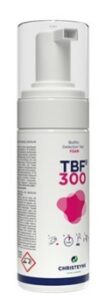
Importantly, it is designed to complement existing hygiene monitoring rather than replace it. TBF 300 provides QA and hygiene teams with a practical approach to biofilm detection in food processing, particularly when investigating accessible open surfaces.
We recommend using the test after cleaning and disinfection at defined sampling points.
This makes it particularly useful as an investigative tool when QA teams are trying to identify potential biofilm reservoirs within a processing environment.
How Is TBF 300 Used for Biofilm Detection in Food Processing factories?
The procedure is deliberately simple.
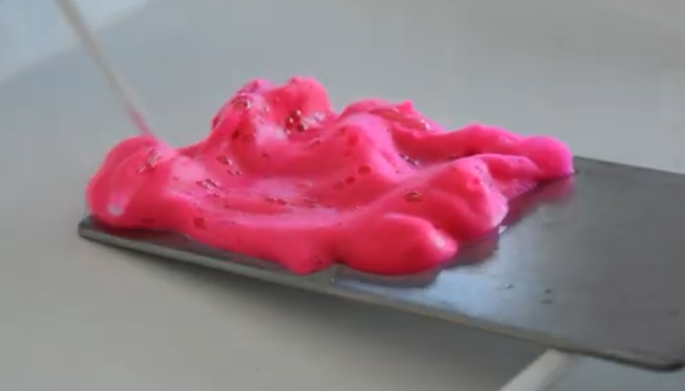
- Apply TBF 300 foam to approximately 10 cm² of the surface.
- Allow a contact time of at least five minutes.
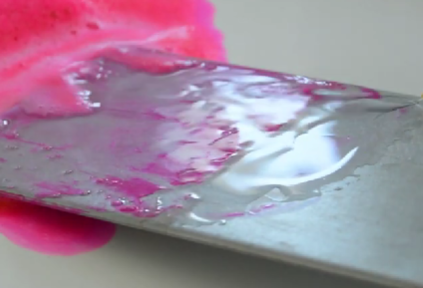
- Rinse the test area with water.
- Check the surface. Pink colour remaining after rinsing indicates the presence of biofilm.
That gives the hygiene or QA team something extremely valuable:
A visible indication of where corrective action needs to be focused.
One important limitation is that TBF 300 should not be applied to porous materials such as wood, fabric or cardboard because they may permanently retain the dye. The manufacturer also recommends testing a small area first if there is uncertainty about material compatibility.
Where should QA teams use TBF 300?
Random testing can be useful, but a risk-based biofilm survey is much more powerful.
Start by thinking like a biofilm.
- Where could microorganisms attach?
- Where might water remain?
- Where could organic residue accumulate?
- Which surfaces are hardest for the cleaning team to reach?
- Where have you previously experienced positive microbiological results?
- Which parts of equipment are repeatedly implicated during investigations?
Those become your priority sampling points.
The objective isn’t simply to perform a certain number of tests.
The objective is to find the reservoir.
TBF 300 vs Biofinder: what’s the difference?
This is an important distinction because the two technologies can play different roles in a hygiene investigation.
TBF 300 is the more biofilm-specific tool.
It is used when the question being asked is specifically:
“Is there biofilm on this surface?”
Biofinder is a broader hygiene investigation tool. It can indicate areas of microbial activity and residual organic contamination and can therefore be extremely useful for identifying areas that warrant further investigation.
A simple way to think about the difference is:
Biofinder asks: “Is there something here that concerns me from a hygiene perspective?”
TBF 300 asks the more specific question: “Is biofilm present here?”
Used intelligently, these tools can complement conventional microbiological monitoring and help QA teams build a much clearer picture of what is happening within the processing environment.
A positive TBF 300 result is not the end of the investigation
This is perhaps the most important point.
Finding the biofilm doesn’t solve the problem.
It tells you where the problem is.
The manufacturer’s technical data sheet recommends cleaning and disinfecting a positively identified surface using biofilm-removing products.
This is where the real work begins.
A mature biofilm isn’t simply a collection of microorganisms sitting on a surface. The microorganisms are embedded within a protective extracellular polymeric substance, or EPS matrix.
If we want to deal effectively with an established biofilm, we need to address that protective structure rather than treating the problem as ordinary surface contamination.
This is where targeted biofilm-removal enzyme chemistry becomes particularly valuable.
The objective is to disrupt and remove the biofilm structure so that the underlying contamination can be effectively addressed.
From microbial spikes to finding the source
This approach becomes particularly valuable when dealing with persistent, intermittent microbiological spikes.
At Innogiene, we have worked with food processing facilities where microbiological problems repeatedly disappeared after corrective cleaning, only to return later.
In a number of these facilities, identifying and targeting hidden biofilm reservoirs formed an important part of resolving the recurring problem.
That experience has reinforced a principle that sits at the centre of our approach to biofilm management:
You cannot effectively control a biofilm problem until you know where the biofilm is.
Detection should lead to action
A practical biofilm management programme should therefore follow a logical progression:
Detect → Investigate → Remove → Verify → Prevent
Detection helps identify the problem.
Investigation helps determine its extent and likely cause.
Targeted enzyme cleaning helps remove established biofilm.
Verification helps establish whether corrective action has been successful.
And preventative intervention helps reduce the likelihood of the biofilm becoming established again.
This is far more useful than repeatedly responding to microbial spikes without identifying the underlying reservoir.
The bigger picture: open surfaces and closed systems
TBF 300 is designed for accessible, open surfaces.
But food factories also contain closed systems where visual inspection and direct surface testing aren’t possible.
Pipelines, tanks and other closed water or process systems therefore require a different monitoring strategy.
This is why a comprehensive biofilm programme needs to distinguish between:
Open-surface biofilm detection, where tools such as TBF 300 can be used to investigate accessible surfaces.
And real-time biofilm monitoring in closed systems, where technologies such as the ALVIM Biofilm Sensor can detect bacterial settlement inside pipelines and water systems.
The technology changes, but the principle remains the same:
Find the biofilm before deciding how to fight it.
Biofilm detection is the beginning, not the end
TBF 300 gives QA and hygiene teams a practical way to investigate something that is otherwise extremely difficult to see.
But the greatest value comes from what happens after that positive result.
A pink indication should trigger a question:
Why has biofilm developed here, and what are we going to do about it?
That’s when biofilm detection moves from being another hygiene test to becoming a valuable problem-solving tool. Effective biofilm detection in food processing should ultimately lead to targeted corrective action, verification and prevention
And when you’re dealing with persistent contamination, finding that hidden reservoir can completely change the direction of the investigation.
Innogiene
Experiencing Persistent or Unexplained Microbial Spikes?
Recurring contamination may be a sign that a hidden biofilm reservoir is being missed.
Innogiene works with food processing facilities to detect biofilm, identify problem areas and implement targeted biofilm removal and prevention strategies.
- Talk to us about your biofilm challenge
- info@innogiene.co.za
- +27(0)76 284 7878